24th September 2026
Green roofs have become one of the most effective ways of introducing biodiversity into the built environment. They create habitats for wildlife, improve rainwater management, reduce the urban heat island effect and contribute to healthier, more sustainable buildings. As rooftops increasingly become valuable amenity spaces, however, designers are asking a different question – how can roofs successfully balance biodiversity with the practical demands of everyday use, writes Justin Pitman, Sales Director at Proteus Waterproofing®?
There is no single solution for every project. This is because today’s roofs often need to perform multiple functions, by providing environmental benefits while also creating safe, attractive spaces for people to work, relax and socialise. The most successful designs recognise that different roof areas have different purposes and specify the most appropriate surface finish for each.
We must therefore recognise that not all green roofs are the same. Extensive green roofs, for example, are primarily designed to maximise biodiversity and environmental performance. Typically planted with sedum, wildflowers or low-maintenance vegetation, they are intended to support wildlife, improve Sustainable Drainage Systems (SuDS) and enhance the environmental credentials of a building. They are generally not designed to accommodate regular pedestrian traffic.
However, where regular pedestrian traffic is expected, hard landscaping continues to provide an excellent solution. Concrete paving, resin-bonded paving systems and porcelain tiles are widely used to create roof terraces, circulation routes, seating areas and communal spaces. These finishes are durable, low maintenance and well suited to heavily trafficked environments.
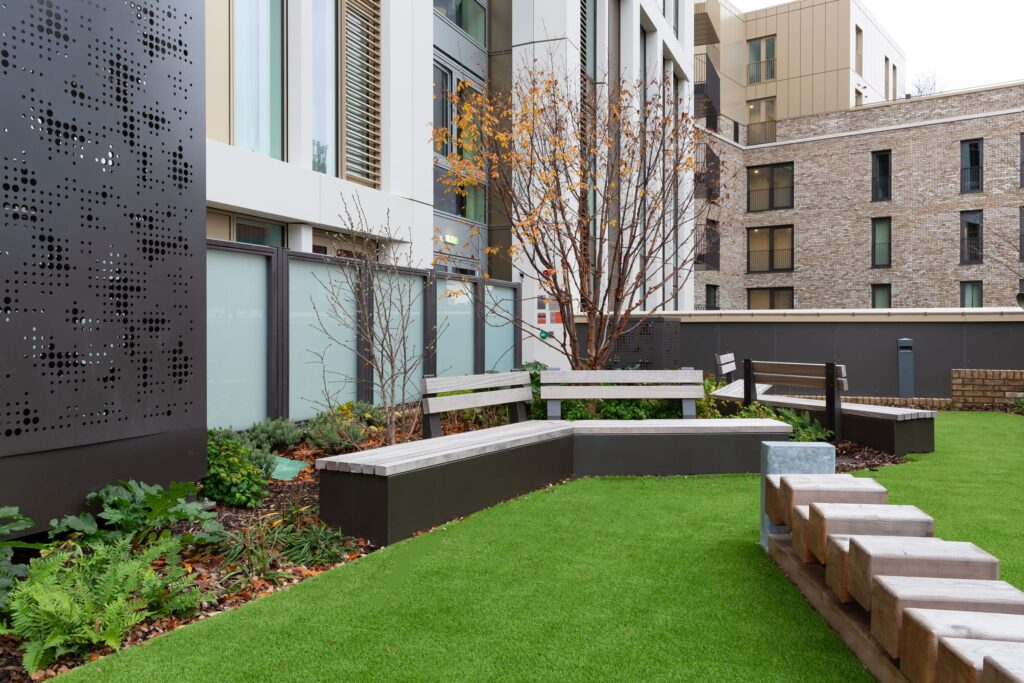
Rather than viewing roof design as a choice between green roofs and hard landscaping, architects are increasingly adopting a zoned approach, allowing each area of the roof to perform differently – which is why artificial grass is increasingly seen as an alternative solution.
Where Artificial Grass Fits
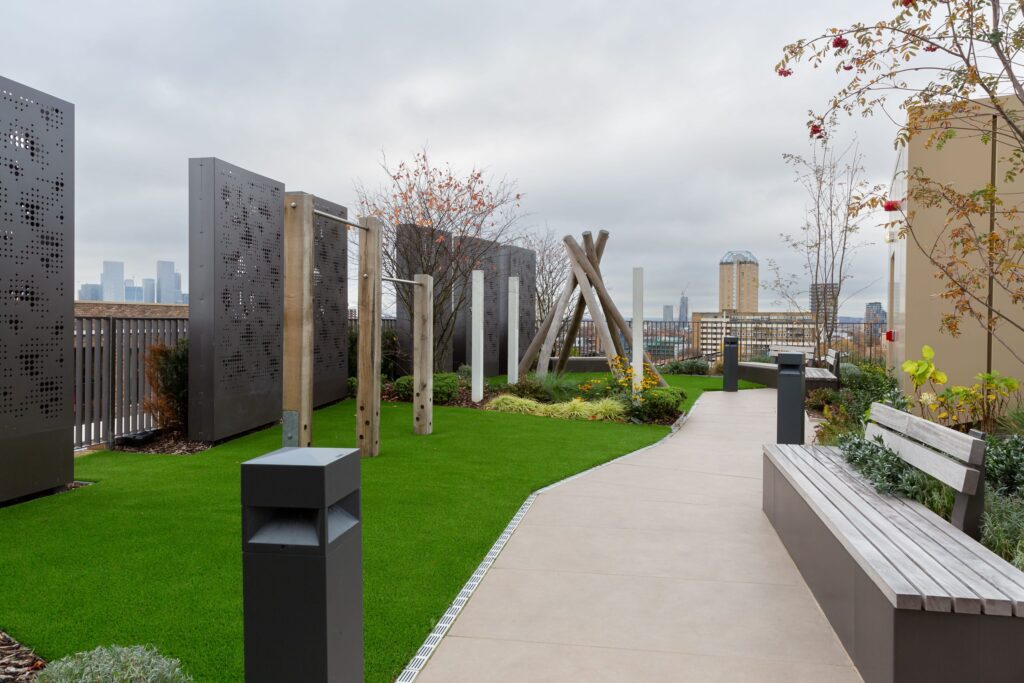
It provides designers with another surface finish that can complement both planted areas and hard landscaping. Artificial grass systems create a softer, more natural aesthetic than traditional paving while providing a durable surface for pedestrian use.
This can be particularly beneficial on roof terraces adjoining residential developments, offices, healthcare facilities, schools and hospitality venues, where creating an attractive outdoor environment is just as important as delivering practical performance.
By directing foot traffic onto durable artificial grass or hard landscaped areas, planted zones are protected from excessive wear while continuing to deliver their environmental benefits.
Artificial grass can also solve a challenge that is often overlooked. Current fire regulations require green roofs to incorporate a perimeter fire break, typically comprising a 300–500mm border of cobbles around the planted area. On narrow or relatively small roofs, this fire break can occupy a significant proportion of the available roof space, leaving very little room for meaningful living roof finishes or planting.
In these situations, Evergreens® UK EverRoof® artificial grass provides an attractive, softer alternative that delivers the desired visual appearance without sacrificing valuable usable space.
Similarly, some roof areas are simply unsuitable for living vegetation for other reasons including aspect and exposure. Rather than specifying planting that may be inappropriate, artificial grass offers a practical solution where a softer landscaped appearance is still required.
A Complete Fire-Tested Roofing System
Whatever surface finish is selected, system design is critical. Modern architects, principal contractors and warranty providers increasingly specify complete roofing systems rather than assembling individual components from multiple manufacturers. This approach provides confidence that every element of the roof has been designed, tested and certified to work together.
Recognising the growing demand for multifunctional roof spaces, Proteus Waterproofing® has worked with Evergreens® UK to develop fully tested roofing systems that combine EverRoof® artificial grass with the Proteus Pro-BW® waterproofing and insulation system. Together, these systems have achieved BROOF(t4) classification, the highest European standard for external fire performance of roofing systems.
Importantly, BROOF(t4) certification applies to the complete roof build-up and not just individual products tested in isolation. For architects and major building contractors delivering new-build projects, this provides confidence that the waterproofing, insulation, artificial grass and associated components have been tested together as a complete roofing system – and that is key to the entire roof design.
www.proteuswaterproofing.co.uk