
29th September 2026

Roofing marketing on Google mainly uses three channels: paid directories, trade associations and the roofer’s own website. Across 10 English counties, roofing company websites held 49 of the 97 organic results on page one of Google for “roofers in [county]”, paid directories and lead platforms held 39, trade associations and approved-trader schemes held 6, and social media pages held 3 (live Google results, 27 September 2026). Paid directories took 15 of the 30 top-three places, and every search showed a map pack of three local roofers’ Google Business Profiles. This article sets out the data, what a paid listing costs, what happens when a roofer stops paying, and how the three channels work together.
Roofing marketing is any channel a roofing company uses to reach homeowners who need roofing work, and on Google three channels compete for the same searches: paid directory listings, trade association listings, and the roofer’s own website with its Google Business Profile.
Of these three channels, paid directories have existed since the beginning of the web revolution. Quite like traditional paper directories, these are online directories that charge a membership fee to show your business information – they work, as they are focused and easy to navigate, and many people still rely on them for the information.
A trade association listing is even more focused, since every trade has its association providing info solely related to that business. They are often highly trusted by the readers.
Then, of course, is the Google Business Profile, along with your website provide all relevant details of your business.
And, remember that some traditional ways of finding business, including referrals, leaflets, and signwritten vans, still work. However, these traditional channels do not compete with Google results; hence this article does not discuss them.
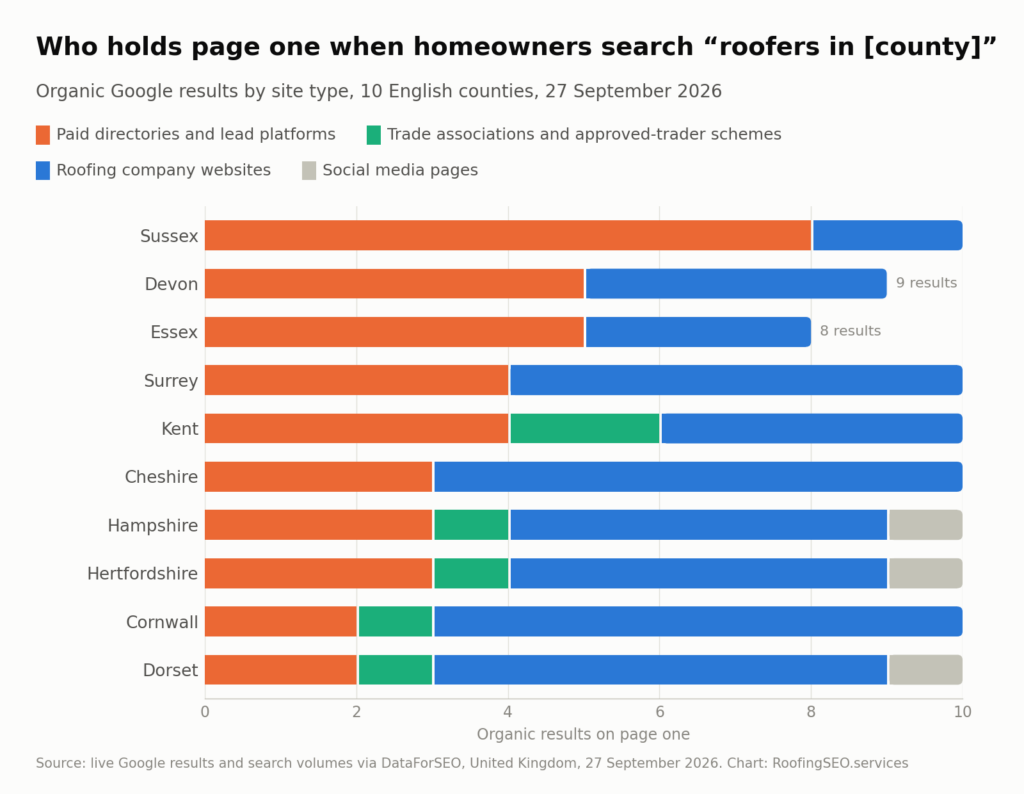
Roofing company websites hold about half of page one for county roofer searches and paid directories hold about two in five: 49 and 39 of the 97 organic results across 10 counties.
| County | Paid directories | Trade associations and approved-trader schemes | Roofing company websites | Social media | Organic results |
| Sussex | 8 | 0 | 2 | 0 | 10 |
| Devon | 5 | 0 | 4 | 0 | 9 |
| Essex | 5 | 0 | 3 | 0 | 8 |
| Surrey | 4 | 0 | 6 | 0 | 10 |
| Kent | 4 | 2 | 4 | 0 | 10 |
| Cheshire | 3 | 0 | 7 | 0 | 10 |
| Hampshire | 3 | 1 | 5 | 1 | 10 |
| Hertfordshire | 3 | 1 | 5 | 1 | 10 |
| Cornwall | 2 | 1 | 7 | 0 | 10 |
| Dorset | 2 | 1 | 6 | 1 | 10 |
| All 10 counties | 39 | 6 | 49 | 3 | 97 |
What strategy works differs by county, so a “one-size-fits-all” approach does not work. Using the same template for different geo areas will only bring moderate success. In Sussex, paid directories delivered 8 of 10 results, while in Cornwall and Dorset they delivered only 2 of 10. Even the position of various directories differs by county; thus, CORC’s county directory pages appeared on page one in 5 of the 10 counties. It generally holds first position in Hampshire and Hertfordshire, second in Kent, seventh in Dorset and tenth in Cornwall. The only other approved-trader result was a county council trading standards scheme in Kent.
Paid directories took 15 of the 30 top-three organic results across the 10 counties, roofing company websites took 12 and trade associations took 3.
| Site type | Top-three results | Share of top-three results |
| Paid directories and lead platforms | 15 | 50% |
| Roofing company websites | 12 | 40% |
| Trade associations and approved-trader schemes | 3 | 10% |
| All 10 counties | 30 | 100% |
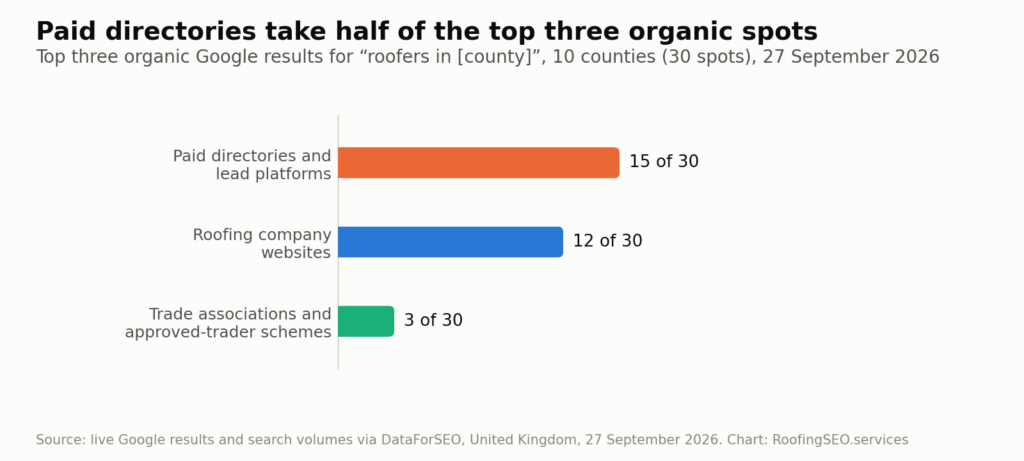
When it comes to the top-three results, paid directories clearly have an edge, and they have the potential to bring half of all the leads. Paid directories led organic results in 7 out of 10 counties surveyed. CORC directory was at the top in Hampshire and Hertfordshire, while in Essex, a roofing company’s website was at the top.
Of course, roofing websites still hold significant importance as they reached the top three in 8 of the 10 counties. However, in Sussex, all three top results were paid directories.
Here, it is important to understand that directory result rankings are for the directory and not for the roofer. These directories show multiple competing roofers side by side. It means that a paid listing can buy a place on this list, but not the Google result itself.
Nevertheless, this highlights the importance of paid listings in these directories. These directories consistently list in the top 3 places in organic search results in most counties. So, if any company opts for a paid listing can quickly start getting leads.
When a roofer stops paying, the directory removes the roofer’s profile, and the page the roofer paid to appear on keeps ranking for the directory.
Most roofers pay for 12 months of listing, which is enough to understand the benefits of that listing. One can cancel the renewal if one is not interested. Once the membership period ends or the listing is cancelled, the directory immediately stops showing.
However, the benefits of listing in these directories last much longer. Reviews on your Google Business Profile remain yours. Over that period, you might have made some loyal clients who continue to spread the word of mouth. Similarly, these listings also help boost the position of your website in the search engine.
If you join back the same directory after some gap, your previous reviews in that directory still remain, and the directory republishes a limited number of the roofer’s earlier reviews.
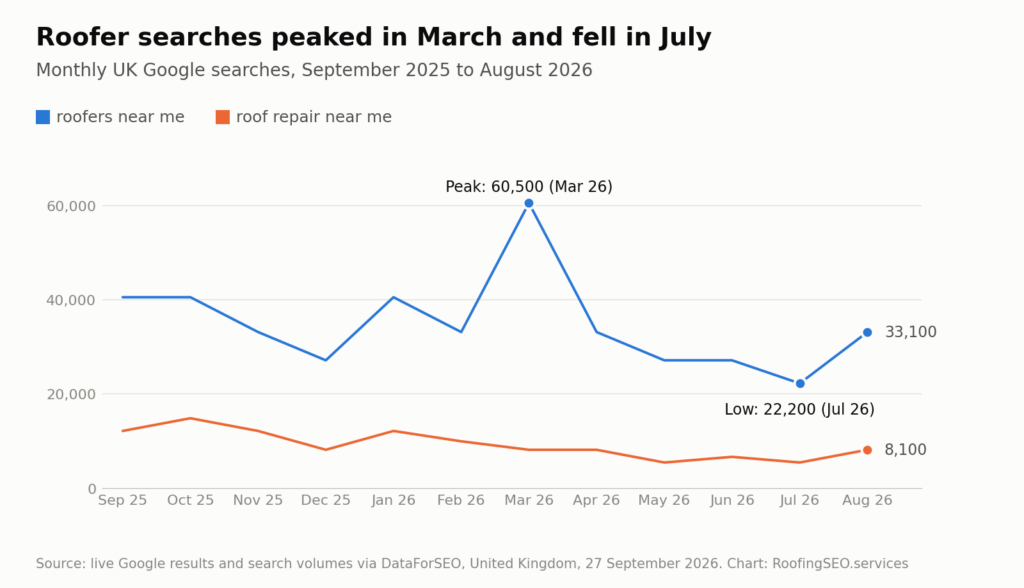
UK searches for “roofers near me” peaked at 60,500 in March 2026 and fell to 22,200 in July 2026, while searches for “roof repair near me” peaked at 14,800 in October 2025.
| Month | “roofers near me” | “roof repair near me” |
| Sep 2025 | 40,500 | 12,100 |
| Oct 2025 | 40,500 | 14,800 |
| Nov 2025 | 33,100 | 12,100 |
| Dec 2025 | 27,100 | 8,100 |
| Jan 2026 | 40,500 | 12,100 |
| Feb 2026 | 33,100 | 9,900 |
| Mar 2026 | 60,500 | 8,100 |
| Apr 2026 | 33,100 | 8,100 |
| May 2026 | 27,100 | 5,400 |
| Jun 2026 | 27,100 | 6,600 |
| Jul 2026 | 22,200 | 5,400 |
| Aug 2026 | 33,100 | 8,100 |
The two searches peak at different times. “Roofers near me” reached its high in March 2026, and “roof repair near me” reached its high in October 2025 and stayed at 12,100 or more from September to November 2025 and again in January 2026. In July 2026, searches for “roofers near me” ran at just over a third of the March peak.
A fixed monthly directory fee costs the same in July as in March. Pay-per-lead pricing rises and falls with enquiries but charges for every lead, won or lost. A roofer’s own website and Google Business Profile carry no monthly listing fee, so the quiet months cost nothing extra and the pages are already ranking when demand returns.
A trade association listing adds independent proof that the roofer has been checked, and CORC’s county directory pages ranked on page one of Google in 5 of the 10 counties tested.
CORC’s county pages ranked first for Roofers in Hampshire and Roofers in Hertfordshire searches, ahead of every paid directory in those two counties. CORC checks a roofing business before listing it. The published entry requirements for Trade Membership include:
CORC members can also offer an insurance-backed guarantee that covers the full contract value of new roofing work and materials for 10 years if the member ceases trading; the guarantee does not cover repairs. The terms are on CORC’s Insurance Backed Guarantees page. CORC’s code of conduct also asks members to avoid cold calling.
A Google search for “roofers in dorset” on 27 September 2026 showed one CORC member in two places on the same page: the map pack and CORC’s own directory result.
Trueline Roofing Ltd, a roofing company based in Swanage and a CORC member since January 2026, appeared third in the map pack with a 5.0-star rating from 28 Google reviews. CORC’s Dorset directory page ranked seventh in the organic results, and Google’s snippet for that page named Trueline Roofing Ltd. Trueline’s own website carries separate pages for roofers in Poole, Bournemouth and Weymouth, the town searches a county page does not target.
The above example shows how three channels complement each other. The Google Business Profile won in this case, while the CORC listing further helped boost the confidence of individuals searching for roofing services in this area. So, naturally, such a company is more likely to get a call. These channels are further supported by a website, which provides more detailed information regarding services provided in that town or search area.
A roofer’s own website competes for the largest share of page one: roofing company websites held 49 of the 97 organic results and 12 of the 30 top-three results across the 10 counties.
If your business is appearing in the top three in a directory listing or Google Business Profile for that country, this does not mean that the website does not matter. Things are far more complex, and every signal matters for search engines. Google Business Profile is only likely to show your business in the top three positions if you have a well-updated, SEO-optimized website. Before showing any business profile among the top three listings, Google checks its website for its latest address, activity, and articles, and more. It also looks for its listing in directories and reviews.
This means that if a business has a dedicated page for that service and for that town or county, Google will prioritise that listing. A website page provides Google additional information and confidence.
If a business still needs a listing in a paid directory to boost its rating, one can learn more about it in this guide to SEO for roofers. To compete for county and town searches, a roofing company website needs:
None of these items stops working when a subscription ends.
A roofer should use a trade association listing for vetted proof, its website and Google Business Profile as the long-term channel, and a paid directory only where the numbers show it wins jobs at a profit. Work through the channels in this order:
Recording where every enquiry came from gives step 5 real numbers to work with.
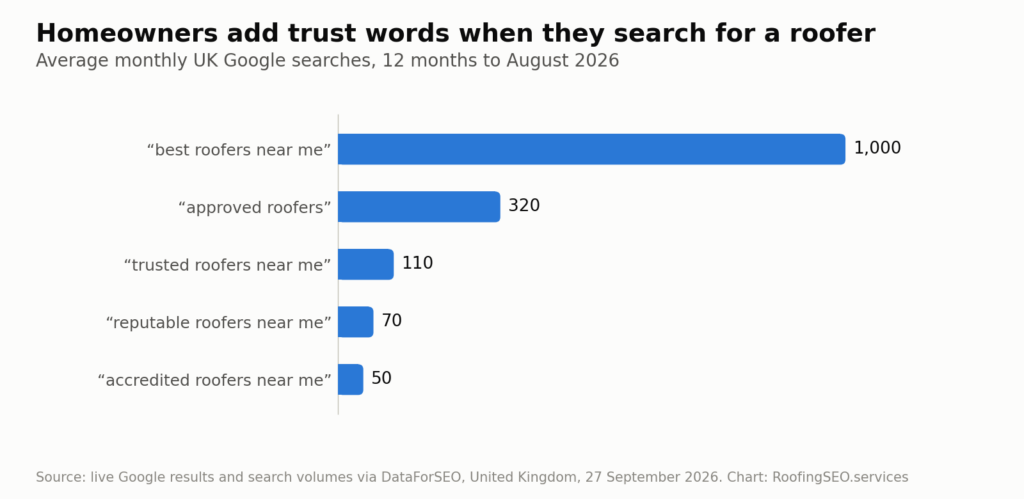
Homeowners add trust words to roofer searches: “best roofers near me” draws about 1,000 UK searches a month and “approved roofers” about 320.
| Search | Average monthly UK searches |
| best roofers near me | 1,000 |
| approved roofers | 320 |
| trusted roofers near me | 110 |
| reputable roofers near me | 70 |
| accredited roofers near me | 50 |
Although these numbers are much smaller than 33,100 monthly UK searches for “roofers near me”, they do show what homeowners are looking for. So some of them might be looking for a roofer with the most reviews, while others are looking for one listed in some trusted business directories. So, for example, one is more likely to be shown for the search “approved roofers” if their website mentions roofer’s trade association membership and guarantee terms in plain words match the wording of these searches.
No single channel wins on its own: in the 10 counties tested, roofing company websites held the most page-one results, a map pack of three Google Business Profiles appeared in every search, and CORC’s county pages ranked first in two counties. The data supports a mix of a website and Google Business Profile the roofer owns, a vetted trade association listing, and a paid directory only where it wins jobs at a profit.
A paid directory is worth it for a roofer when the jobs it wins each year cover its annual cost at the roofer’s margin. A listing costing £3,000 a year needs 3 jobs at a £1,200 margin to break even.
Yes: roofing company websites held 49 of the 97 organic page-one results and 12 of the 30 top-three results across the 10 counties tested. In Essex, a roofing company website ranked first.
The reviews stay with the directory. One national directory republishes only a limited number of a returning member’s earlier reviews. Reviews on a roofer’s Google Business Profile stay with the business.
CORC’s county directory pages appeared on page one in 5 of the 10 counties tested and ranked first in Hampshire and Hertfordshire, so a CORC listing can put a member on page one through CORC’s own page.
The page-one data comes from 10 live Google searches for “roofers in [county]”, run on Google UK desktop on 27 September 2026 through DataForSEO. The counties were Kent, Surrey, Essex, Devon, Hampshire, Sussex, Cornwall, Cheshire, Hertfordshire and Dorset.
Google results vary by the searcher’s location and change from day to day. The full classified list of results is available on request.