
3rd November 2026
Britain’s rainfall is changing in a striking way. The country is not necessarily getting wetter overall; rainfall is just becoming more unpredictable, with longer dry spells, wetter winters, and more frequent intense downpours, writes Justin Pitman, sales director at Proteus Waterproofing.
A drainage system designed around yesterday’s rainfall patterns is increasingly being asked to cope with tomorrow’s extremes. Roads, sewers and rivers can only move so much water, so quickly. When an intense storm hits an urban area of roofs, roads and paving, the question becomes brutally simple – where does all that water go? Increasingly, the answer is to keep some of it on the roof.
The latest Met Office evidence makes uncomfortable reading for anyone responsible for drainage. The UK’s most recent decade, 2015–2024, was 10% wetter than 1961–1990, while the winter half-year was 16% wetter. Five of the UK’s 10 wettest years since records began in 1836 have occurred since 2000. Months in which counties recorded at least twice their 1991–2020 average rainfall increased by more than 50% over the same comparison.
Even more alarming, rainfall events exceeding 50mm have become more frequent. Summers may become drier overall, but the rain that does fall is expected to be more intense: a typical summer event that currently occurs once every two years could produce around 25% more rainfall.
The Climate Change Committee goes further. It says extreme rainfall is increasing in all seasons, with the most extreme events potentially rising by 15–75% and short-duration rates above 20mm per hour becoming around four times more frequent. The result is more intense rainfall over shorter periods, placing greater demands on drainage capacity.
What could the next 10 years look like?
The Met Office’s National Flood Resilience Review found that even under the current climate there is a 7% chance in any winter of record monthly rainfall in south-east England, rising to 34% across England and Wales together. Another record-breaking rainfall event is not some distant climate scenario – it is a present-day risk.
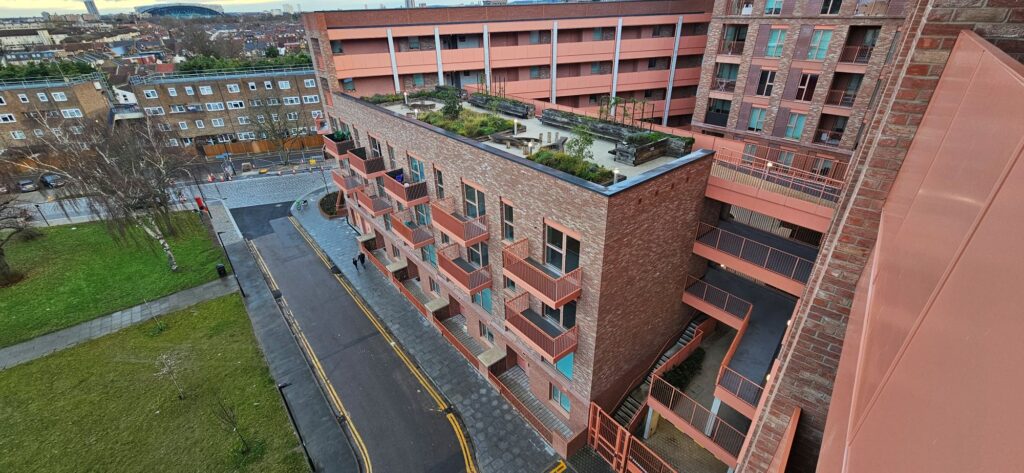
That is why blue roofs are becoming increasingly relevant. The principle is remarkably simple. Instead of rainwater running immediately from the roof into gutters, downpipes and ultimately the drainage network, a blue roof provides a controlled storage layer. Rain is temporarily retained, then released at a controlled rate through flow-restricting outlets.
A conventional roof turns a rainfall event into an immediate hydraulic response. A blue roof introduces a delay and controls the discharge rate, helping prevent a sudden surge entering an already stressed drainage network.
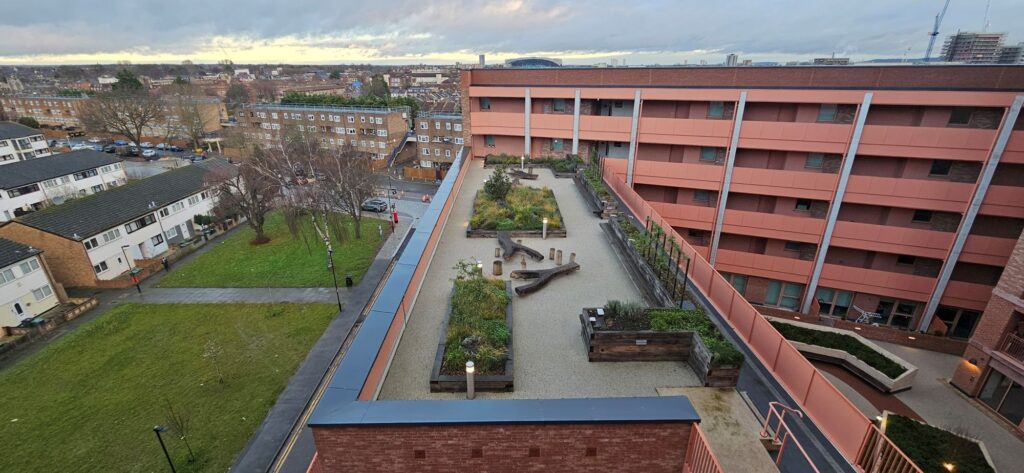
London and other major cities have recognised the potential of an effective blue roof programme, and there is now a growing body of evidence demonstrating what blue and blue-green roofs can achieve.
The next generation of blue roofs
Blue roofs are becoming more sophisticated. Blue-green roofs now combine water storage with vegetation, while newer ‘smart’ systems use weather forecasting to manage stored water before a major storm arrives.
Research has demonstrated the potential scale of the benefit. One study found forecast-controlled blue-green roofs could capture between 70% and 97% of extreme precipitation above 20mm per hour, although performance varies with system design and the rainfall event.
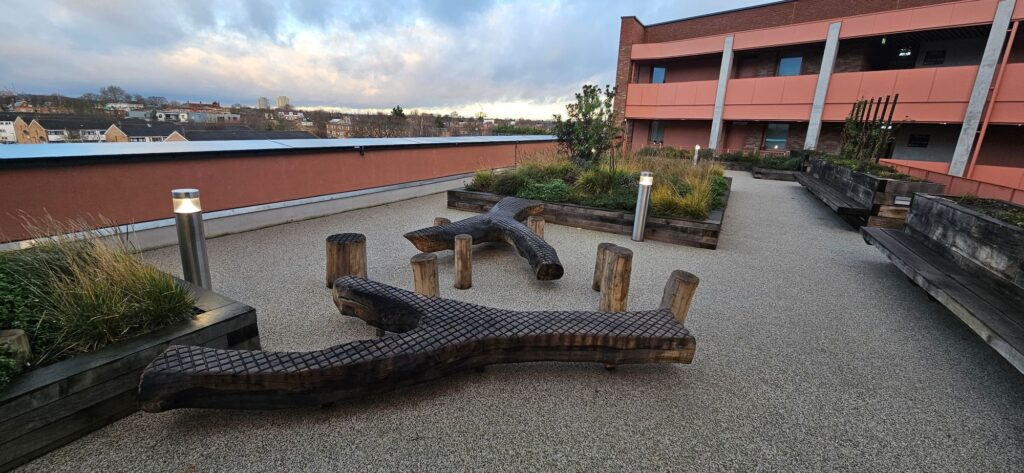
A blue roof’s capacity is not unlimited, so it must be correctly designed, structurally assessed, waterproofed, maintained, and provided with safe exceedance routes. That is not an argument against blue roofs; it is an argument for designing them properly, which is why Proteus provides an extensive design and technical service for architects, contractors and building owners.
The Environment Agency’s latest figures suggest surface-water flood risk already affects millions of properties in England and could affect millions more. The Met Office warns that intense rainfall is becoming a more significant feature of our climate, and government policy increasingly demands that new developments manage water sustainably. The blue roof therefore represents something bigger than another roofing specification.
Instead of simply moving rainwater away as quickly as possible, we can increasingly design buildings to hold it, control it and release it when the drainage system is better able to cope – and over the next decade, as the UK becomes accustomed to more intense rainfall events, that difference could become increasingly important.
www.proteuswaterproofing.co.uk